Muscle Groups: Understanding the Main Muscles of the Body to Train Better

Muscle Groups: What Are the Main Muscles to Know in Strength Training?
When you start strength training, you quickly hear about the chest, back, legs, or abs. Yet many beginners go through exercises without really knowing which muscles they are working or how to group them in a logical way. Understanding muscle groups helps you read a program better, choose your exercises better, and avoid building unbalanced workouts.
The goal of this article is not to go into every anatomical detail. It is instead meant to serve as a clear base to identify the main muscle groups of the body, understand their role in training, and see how they fit into a strength training routine. Then, each group can be covered in more depth in a dedicated article.
What Does Muscle Group Mean?
A muscle group refers to a set of muscles located in the same area of the body or involved in similar movements. In practice, you do not always talk about each muscle separately when building a workout. You often think in terms of larger areas: chest, back, shoulders, legs, arms, abs.
This way of classifying muscles is useful because it simplifies how workouts are organized. Instead of thinking only in terms of exercises, you better understand which parts of the body are being used, which ones need rest, and how to spread the work across the week. In strength training, this logic is important because the same movement often involves several muscles at the same time.
Knowing the muscle groups first helps build more coherent workouts. A person who knows that a bench press mainly works the chest, but also the triceps and shoulders, better understands why some muscles are already tired on the following exercises. On the other hand, someone who only looks at the names of the exercises may feel like they are adding variety while still overloading the same areas.
This base is also useful for balancing your training. Many beginner lifters focus on the arms or abs because they are very visible muscles, but neglect the back, legs, or glutes. In the medium term, this creates an incomplete program that is often less effective. Knowing the muscle groups better therefore helps distribute the work in a cleaner way.
Finally, it helps understand recovery. If a muscle group has already been heavily worked, it will not always be smart to train it heavily again the next day. Even without getting into a complex program, this logic helps avoid many simple mistakes.
Upper-Body Muscle Groups
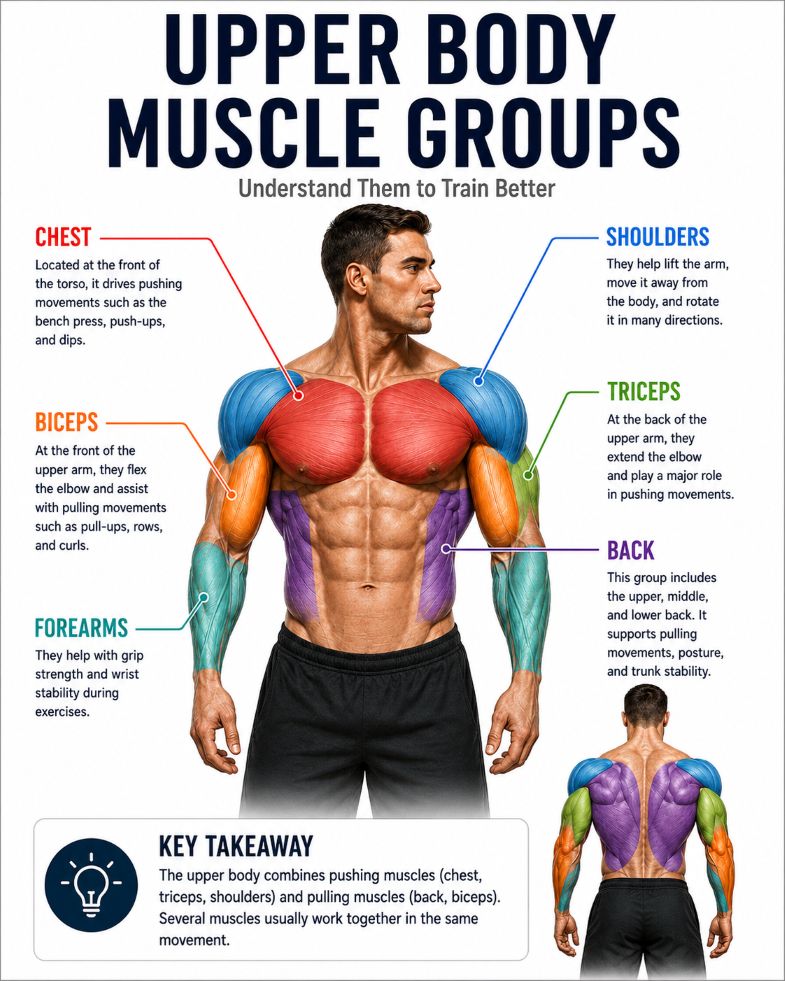
The upper body includes several areas that are trained a lot in strength training. Some are mainly used in pushing movements, others in pulling movements, and some stabilize the whole body.
The Chest
The chest is located at the front of the torso. In strength training, it is mainly associated with movements where you push a load in front of you. You find it on exercises such as the bench press, the incline bench press, or push-ups.
It is one of the best-known muscle groups, but it almost never works alone. When you train the chest, the shoulders and triceps often take part in the movement as well. This is why it is usually included in a “push” workout logic, meaning one focused on pushing movements.
The Back
The back represents a large muscle area, with several important muscles. Without going into the details of each one here, the main thing to remember is that the back is involved in pulling movements, posture support, and the overall stability of the upper body.
In strength training, it is worked with exercises such as pull-ups, pulldowns, or rows. It is a central muscle group because it is not only used to gain width or visual thickness. It also plays an important role in body balance, positioning during exercises, and overall posture quality.
The Shoulders
The shoulders are mainly represented by the deltoids. They are involved in many upper-body movements, whether it is to raise the arms, push a load overhead, or stabilize certain movement paths.
In practice, the shoulders are worked on dedicated exercises such as lateral raises or the overhead press, but also on many chest movements. They therefore require some attention in how workouts are organized, because they can accumulate fatigue faster than you might think.
The Biceps
The biceps are located at the front of the arm. They are mainly known for their role in elbow flexion, in other words when you bring the forearm closer to the upper arm. They are worked directly with curls, but they also take part in many pulling exercises for the back.
This muscle is often highlighted by beginners because it is visible and easy to identify. Still, it is important to keep in mind that it remains an assisting muscle on many upper-body movements. It should therefore not take up all the space in a program.
The Triceps
The triceps are located at the back of the arm. Their main role is elbow extension, so the action of straightening the arm. They are heavily involved in pushing exercises such as presses, dips, or certain cable movements.
Like the biceps, the triceps are very well known, but they should not be seen in isolation. They often provide support on exercises for the chest and shoulders. This explains why a muscle that is already tired on a basic exercise can limit performance on a more targeted exercise afterward.
The Forearms
The forearms are sometimes forgotten in general presentations, even though they play an important role in grip, holding loads, and controlling certain movements. Even without training them directly, they are already used on pulls, heavy exercises, or movements where grip strength is involved.
They are therefore less often at the center of a workout, but their importance is real, especially for making progress on exercises where grip becomes limiting.
Lower-Body Muscle Groups
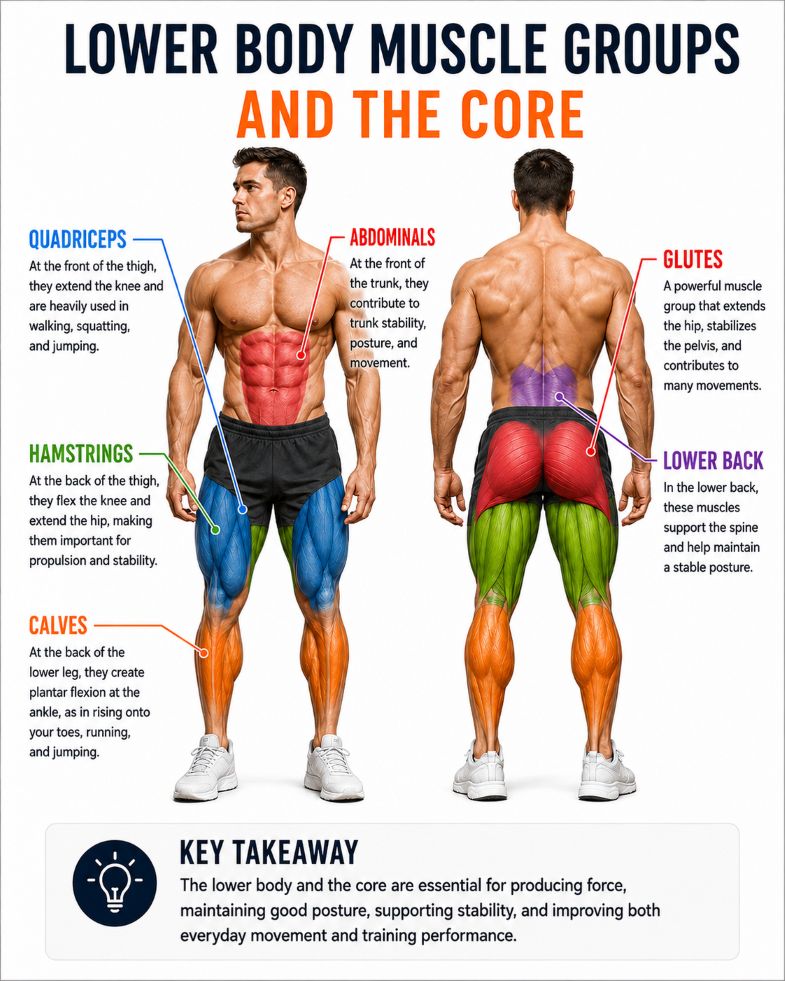
The lower body includes very large muscles, involved in strength, stability, and most athletic movements. In strength training, it is not limited to the thighs: the glutes and calves also have their place.
The Quads
The quads are located at the front of the thigh. They are involved in knee extension in particular and are heavily used on exercises such as the squat, leg press, or lunges.
It is a major muscle group for all leg movements. It takes an important place in lower-body training, but it should not be considered alone, because most effective exercises for the quads also recruit other muscles.
The Hamstrings
The hamstrings are located at the back of the thigh. They complete the work of the quads and play an important role in movements where you bend the leg or mobilize the hip.
In strength training, they are used on exercises such as the leg curl or certain deadlift variations. They are sometimes highlighted less than the quads, but lower-body training remains incomplete without them.
The Glutes
The glutes hold a central place in the lower body. They participate in hip extension, pelvic stability, and many fundamental movements. You find them on the squat, lunges, hip thrust, or deadlift.
They are therefore not only an aesthetic muscle group. In strength training, in sports, and even in everyday movements, their role is major. This is also why they are often included both in leg workouts and in more global approaches to movement.
The Calves
The calves are located at the back of the leg, below the knee. They participate in foot support, pushing into the ground, and moving around. In strength training, they can be worked directly with standing or seated calf raises.
Even though they take up less space in an introductory article, they remain a real lower-body muscle group. Many lifters add them at the end of a leg workout, which clearly shows that they fit into an overall logic rather than into a separate isolated approach.
The Muscles of the Core
The core includes the muscles that help maintain the trunk, provide stability, and transfer force between the upper and lower body. In strength training, this area is often summed up too quickly as the abs, even though it plays a much broader role.
The Abs
The abs serve to stabilize the trunk, control certain flexions, and maintain good body position on many exercises. They should therefore not be seen only as a “visual” muscle group.
They are trained with specific exercises such as planks, leg raises, or certain crunch movements, but they also take part indirectly in many basic movements. As soon as you need to keep a solid posture under load, they have a role.
The Lower Back
The lower back is located in the bottom part of the back and helps maintain the trunk. It is involved in stability, positioning, and body control on many exercises, especially those where the torso must stay strong and aligned.
It is rarely the first muscle a beginner thinks of, yet it is very important in the whole posterior chain. Its role becomes especially clear once you start doing more complete and more demanding exercises.
Main Muscle Groups and Secondary Muscles
In strength training, an exercise almost never works only one muscle. There is generally a main muscle group, the one you are mainly trying to target, and secondary muscles that help with the movement or stabilization.
For example, on a bench press, the chest is the main group, but the triceps and shoulders are also involved. On a row, the back takes priority, but the biceps and forearms also participate. On a squat, the quads, glutes, and several core muscles are mobilized together.
This distinction is important because it helps avoid believing that you can perfectly isolate each area. In reality, the body works in movement chains. This is exactly why basic exercises have so much value.
Which Muscle Groups Often Work Together?
Certain combinations come up very often in strength training programs because they follow the logic of movements.
The chest, shoulders, and triceps are often grouped together because they are involved together in most pushing exercises. The back and biceps also go naturally together because pulls strongly involve the arms in assistance. For the lower body, quads, hamstrings, glutes, and calves are generally spread across leg workouts, even if the focus can change depending on the exercises chosen.
This logic explains why many programs are organized around big movement families rather than around small isolated muscles. For a beginner, it is often the simplest way to understand training.
How to Spread Muscle Groups Across a Week
There are several classic ways to spread muscle groups across the week. Full body consists of training the whole body in the same workout. It is an organization often chosen in the beginning because it allows you to work each major muscle group regularly.
Another common approach consists of separating the upper body and the lower body. This method keeps a simple logic while allowing more time to be dedicated to each area. Finally, some lifters use a more detailed split, with a chest workout, a back workout, a leg workout, or even a shoulders and arms workout.
For an introductory article, the most important thing to remember is mainly this: whatever format is chosen, the goal remains to cover the body’s major muscle groups in a balanced way.
Common Mistakes When Discovering Muscle Groups
The most common mistake is focusing almost only on the muscles that are visible in the short term, such as the arms or abs. This often creates unbalanced training, with too little work for the back, legs, or glutes.
Another mistake is wanting to isolate everything from the beginning. Many lifters quickly look for very precise exercises for each small area, while they would benefit more from understanding the major muscle groups and first mastering the basic exercises.
There is also a common confusion between sensation and effectiveness. Just because a muscle “burns” does not necessarily mean it is the only one working, and just because an exercise seems global does not mean it is less useful. In strength training, a large part of progress comes precisely from good overall work.
What to Remember About Muscle Groups
Muscle groups make it possible to simply classify the main areas of the body involved in training: chest, back, shoulders, arms, legs, glutes, calves, abs, and lower back. This view makes strength training easier to understand, especially when you are starting out.
Understanding these groups is not only useful for putting a name on the muscles. It helps you choose your exercises better, organize your workouts better, and understand why some movements work several areas at the same time. It is a useful base for making progress without getting into details that are too technical from the beginning.
This article therefore gives an overview. The logical next step will be to go deeper into each muscle group, with its functions, main exercises, common mistakes, and place in a strength training program.